

What Food Banks Are Really Buying from a Mixing Center
When food banks order from a VAFS mixing center, they aren’t just purchasing smaller quantities of a wider variety of goods. They’re purchasing the logistics infrastructure that makes those smaller unit sizes possible: warehousing, quality inspection, inventory rotation, and order verification. Every pallet. Every expiration date. Every order.
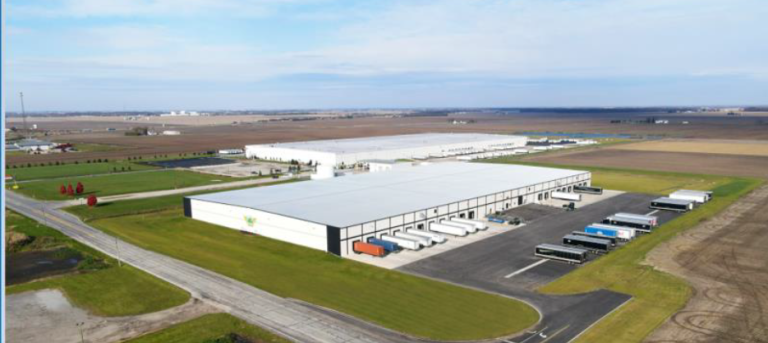
At the Remington, Indiana, mixing center, that infrastructure is operated by Smith Transport Warehouse, a team that has been managing food-grade warehousing for nearly four decades.
Travis Colebaugh, who has spent 36 years with Smith, oversees the Remington operation. VAFS is one of the larger partners in Smith’s warehouse and the fastest-turning customer in their portfolio.
“When inventory comes in, it rotates very quickly,” Colebaugh says. “It keeps things nice and steady. You don’t have all the peaks and valleys of product coming in and then sitting for six months.”
That speed matters. For food banks, faster inventory turns mean fresher product on the shelf and less waste. For VAFS, it means the mixing center can keep product offerings closely matched to market needs today, not yesterday. And for Smith, it means the partnership works the way warehousing is supposed to: high volume and consistent flow.
What Quality Inspection Looks Like Before Your Order Ships
Food bankers know their way around a warehouse. But the specific quality controls happening at a partner facility before the product ships to them are easy to take for granted when everything arrives as expected.
At Smith’s Remington location, every inbound shipment goes through a multi-step inspection before it enters inventory. Product is offloaded, staged on the dock floor, and visually inspected for damage, broken pallets, and other issues that could affect downstream quality.
“All the product has to be offloaded, staged, walked around, and visually inspected for damage, for busted pallets, for all the things that go into making sure that we’re receiving good product and then shipping out good product,” Colebaugh explains.
The outbound side mirrors the process. Warehouse operators use RF guns to locate inventory based on expiration date, pull it to the staging area, and inspect it again. A supervisor then cross-checks the picked order against the VAFS order to verify accuracy. Any discrepancies are flagged and resolved with the VAFS team before the shipment leaves the building.
It’s a more sophisticated version of basic first-in, first-out (FIFO) inventory management, driven by the exact expiration date of each product rather than just the order it arrived. Because different manufacturers and products can have widely varying shelf lives, particularly in the hunger relief space, expiration-date-driven rotation ensures that food banks receive inventory that provides them with maximum flexibility for warehousing once the product reaches their facility.
What a 400% Demand Surge Looks Like from the Warehouse Floor
In the fourth quarter of 2025, VAFS customers experienced what many food banks across the country were feeling: a sharp spike in demand driven by government shutdown concerns and changes to SNAP benefits. The orders came fast, and they came heavy.
At Smith’s Remington facility, overall volume increased by approximately 400%. Over half of that surge came from VAFS alone.
“We were doing three to four loads a day, and then we went to 16 to 17 loads a day,” Colebaugh recalls.
The timing made it harder. Fourth quarter is already one of the most logistically challenging periods in warehousing. You’re managing high volumes while also managing holidays, vacation schedules, and the end-of-fiscal-year clock. Other customers are pushing to move year-end inventory for tax purposes. The normal rhythm of the operation is already compressed.
“Fourth quarter is always a challenge,” Colebaugh says. “You have all these days off in there, but you’re still incredibly busy. It’s filled with peaks and valleys.”
Smith’s team responded by extending schedules, adding overtime hours, and managing dock space creatively. In a multi-tenant warehouse, space is always at a premium, and the inspection process that protects product quality also requires significant floor area. When inbound volume spikes, every square foot of dock space has to be allocated carefully to keep both receiving and shipping moving.
For food banks, Smith’s expertise during that period was invaluable but almost invisible. When demand surged, the product kept flowing. The warehouse didn’t become a bottleneck. Orders were received, inspected, picked, verified, and shipped, even at four times the normal volume.
Why People Stay for 15 Years and What That Means for Your Product
Smith Transport was founded in 1982 by Barry Smith, who started with five trucks and grew the company to over 1,000 units. Warehousing came later as a natural extension of the trucking operation. Today, Smith operates 1.6 million square feet of warehouse space across multiple facilities, with the Remington location serving as an FDA-registered, NSF-approved food-grade facility on the I-65 corridor.
But the numbers don’t fully explain how the company operates. Colebaugh, who describes founder Barry Smith as a personal mentor, says the culture is built on handshake relationships and a simple commitment to doing what’s right for the customer.
“Everything he has today was originally started based on a handshake or based on the idea that ‘we can do it,’” Colebaugh says. “That’s just been instilled in all of us.”
That culture shows up in the company’s retention numbers. Both employees and customers average 15 years of tenure with Smith, a remarkable figure in an industry known for high turnover.
“I think our employees see that,” Colebaugh says. “It gives everybody a sense of home, being here and working here.”
The long tenure with customers also means Smith is more embedded in their operations and service models than a typical 3PL partner. Smith manages about 11 different customers across its Remington facility, each with unique processes and requirements. Employees develop specialized knowledge across multiple product categories and handling protocols. That experience base is part of what allows the team to absorb a 400% volume surge without sacrificing quality.
The VAFS relationship began with the need to expand regional warehousing capacity as the mixing center network grew. What began as a single facility partnership has expanded over time, with the Remington operation now handling a significant share of VAFS’s Midwest volume.
“We knew it was a good partnership based on the volume and our expertise,” Colebaugh says. “We enjoy the relationship because of the volume, but also because of the level of communication and professionalism in working with VAFS. It would be challenging to work at their volume without buttoned-up processes and strong communication protocols.”
A Freight Assessment from a Company That Started in Trucking
One operational detail that emerged from our conversation with Colebaugh speaks to the broader VAFS partner ecosystem. Smith’s Remington facility works with multiple freight carriers across its customer base, and Colebaugh singled out Watco Logistics, VAFS’s exclusive freight partner, as the standout. It’s worth noting that this assessment comes from a company that was founded in trucking. Smith knows freight.
“They are, by far, the best carrier we’ve seen when it comes to communication and keeping you up to date on where the trucks are,” Colebaugh says.
Where some carriers require daily phone calls and emails just to confirm whether a truck will actually show up, Watco’s reschedules are rare. Colebaugh noted that Smith’s team can spend 20 minutes a day for an entire week rescheduling appointments with some carriers before a trailer finally arrives. With Watco, “those are few and far between.”
For food banks, this is a detail worth understanding: both the freight and warehouse partners are performing at a high level and communicating effectively. That coordination is part of what makes the delivered pricing model work. You’re not just getting a product shipped. You’re getting an integrated operation where the warehouse, freight, and mixing center work together.
The Expansion Problem Food Banks and Warehouses Both Face
Like many food banks evaluating their own facility needs, Smith Transport Warehouse is navigating the challenge of expansion in a high-cost environment.
Colebaugh puts the numbers in perspective: a 100,000-square-foot expansion today would cost roughly the same as the 245,000-square-foot building Smith constructed in 2020. Construction materials, labor, and interest rates have all increased to the point where growth requires careful timing and creative planning.
“It’s difficult to explain to a customer that you could have one property, one building, and you would need two different rates based on what part of the building you would put them in, just because of the sheer cost of construction,” Colebaugh says.
In the interim, Smith is optimizing for efficiency, seeking partners like VAFS whose high volume and fast inventory turns make the best possible use of existing space. It’s a strategy that food banks managing their own warehouse operations might recognize: when you can’t build bigger, you get smarter about how you use what you have.
For VAFS customers, who focus on optimization, means their product is stored by a team that is invested in moving inventory quickly, maintaining quality at every touchpoint, and making the most of every square foot. It’s a behind-the-scenes operation that most food banks will never visit, but one that directly affects the freshness, accuracy, and speed of every order that arrives at their dock.

Partners in the Mission
Company: Smith Transport Warehouse
Headquarters: 153 Smith Transport Rd, Roaring Spring, PA 16673
Indiana Facility: Remington, IN (I-65 corridor)
Founded: 1982
Website: smithwarehouse.com
Spotlight Contact: Travis Colebaugh
What they do: Founded as a trucking company by Barry Smith, Smith Transport has grown into a full-service warehousing and logistics provider operating 1.6 million square feet of warehouse space. The Remington, Indiana, facility is an FDA-registered, NSF-approved food-grade warehouse that serves as a key node in the VAFS mixing center network, providing storage, quality inspection, and order fulfillment for hunger relief organizations nationwide.
Mission: Safety, Service, and Continuous Improvement.
By the numbers:
- 1.6 million square feet of total warehouse space
- 15-year average tenure for both employees and customers
- Fastest inventory turns in Smith’s portfolio from the VAFS product
- Absorbed a 400% volume surge in Q4 2025 without disruption
Smith Transport Warehouse operates the Remington, Indiana, facility that supports VAFS mixing center operations.
To learn more about how VAFS’s partnership network supports your operations, contact us.
Together… we can bring more to the table